

Walk into any modern Indian kitchen today and you’ll probably find two oils sitting side by side: mustard oil and olive oil. One comes with generations of culinary tradition. The other arrives with a global “heart-healthy” reputation.
So which one actually deserves a place in your daily cooking?
Both oils can be healthy when used correctly. But for traditional Indian cooking methods like tadka, deep frying, curries, and pickling, mustard oil often performs better because of its high heat tolerance and bold flavor profile. Extra virgin olive oil shines in low-heat cooking, dressings, dips, and finishing dishes where its natural antioxidants remain intact.
The real key is not choosing one oil forever. It’s matching the right oil to the right cooking method.
Why This Debate Matters in Indian Kitchens
Indian cooking is different from many Western cooking styles. It relies heavily on:
-
High-heat tempering
-
Spice roasting
-
Deep frying
-
Long simmering gravies
-
Layered flavor building
That means an oil that works beautifully in a Mediterranean salad may not perform the same way in a smoking-hot kadai full of cumin, garlic, and dried red chillies.
At the same time, health-conscious Indian families are trying to balance:
-
Heart health
-
Traditional flavor
-
Cooking performance
-
Budget
-
Ingredient quality
That’s exactly where the mustard oil vs. olive oil debate becomes important.
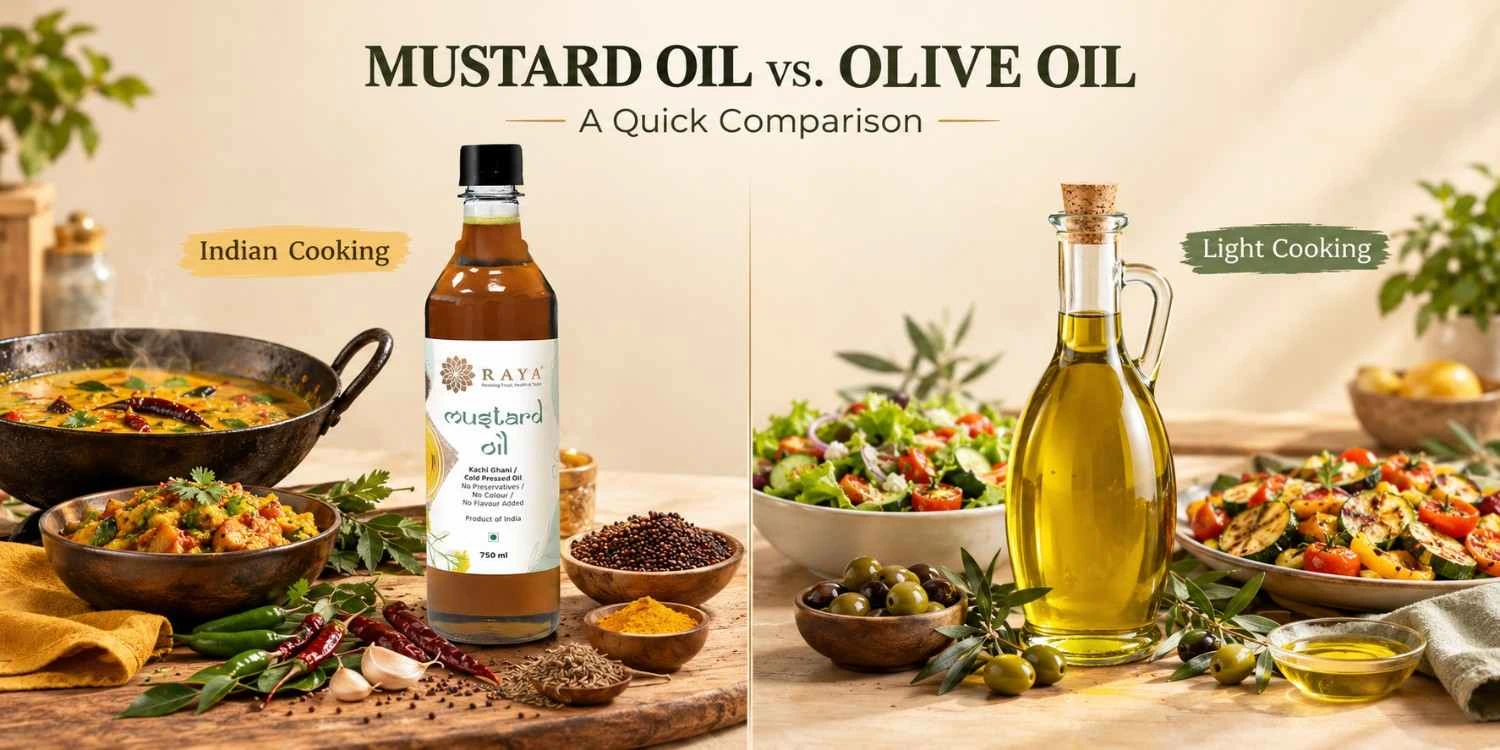
Mustard Oil vs. Olive Oil Comparison
|
Parameter |
Kachi Ghani Mustard Oil |
Extra Virgin Olive Oil |
Refined/Pomace Olive Oil |
|
Smoke Point |
Approximately 240–250°C |
Approximately 190–207°C |
Approximately 230–240°C |
|
Monounsaturated Fats (MUFA) |
Around 60% |
Around 73% |
Around 70–75% |
|
Polyunsaturated Fats (PUFA) |
Around 21% |
Around 11% |
Around 10% |
|
Saturated Fat |
Around 12% |
Around 14% |
Around 15% |
|
Omega-6 to Omega-3 Ratio |
Near-balanced (1.2:1–1.5:1) |
Higher omega-6 ratio |
Minimal omega-3 |
|
Flavor Profile |
Sharp, pungent, earthy |
Fruity, grassy, smooth |
Neutral |
|
Best Use |
Tadka, curries, frying, pickling |
Dressings, drizzling, light sautéing |
High-heat cooking |
The exact nutritional profile varies depending on seed variety, processing method, and storage conditions.
Which Oil Is Better?
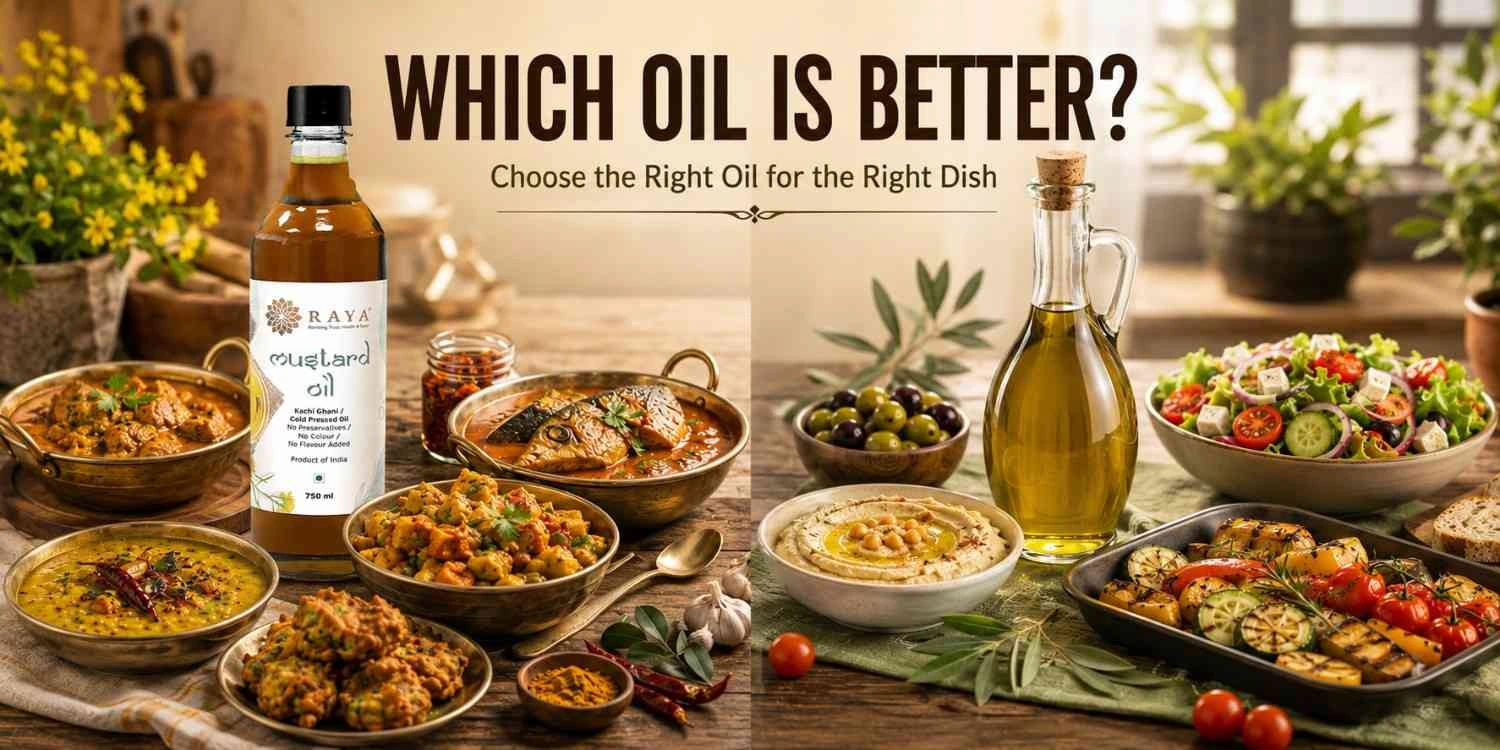
If you cook traditional Indian food regularly, mustard oil is usually the more practical and culturally compatible option.
If you mainly prepare salads, grilled vegetables, dips, or low-heat dishes, extra virgin olive oil is excellent.
The healthiest kitchen often uses both strategically.
Why Mustard Oil Works So Well in Indian Cooking
Mustard oil has been used in Indian kitchens for centuries, especially in Bengal, Bihar, Punjab, Odisha, Assam, and parts of Uttar Pradesh.
And there’s a reason it survived for generations.
It complements the structure of Indian cooking itself.
The moment hot mustard oil hits cumin seeds, garlic, hing, or green chillies, it creates a deep aroma that becomes part of the dish — not just the cooking medium.
I still remember the first time I watched my grandmother prepare fish curry in a heavy iron kadai. She heated the mustard oil just until a thin ribbon of smoke appeared, lowered the flame, and added kalonji and green chillies. Within seconds, the sharp smell softened into something warm, nutty, and intensely appetizing. That transformation is exactly why mustard oil remains unmatched in many Indian recipes.
Benefits of Mustard Oil
1. Excellent for High-Heat Cooking
Traditional Indian cooking frequently crosses temperatures above 180°C during:
-
Tadka
-
Frying
-
Bhuna masala preparation
-
Shallow frying
-
Deep frying snacks
Mustard oil handles these temperatures well because of its relatively high smoke point.
That makes it particularly suitable for:
-
Pakoras
-
Pooris
-
Fish fry
-
Aloo bhaja
-
Chole tadka
-
Pickles
2. Strong Flavor Enhances Indian Spices
Unlike neutral oils, mustard oil contributes character to the dish.
It pairs naturally with:
-
Mustard seeds
-
Garlic
-
Turmeric
-
Green chillies
-
Panch phoron
-
Fenugreek
-
Curry leaves
This is why dishes like Bengali fish curry or sarson wali sabzi lose authenticity when cooked in mild oils.
3. Contains Mostly Unsaturated Fats
Mustard oil contains a large proportion of unsaturated fats, including monounsaturated and polyunsaturated fats.
It also contains alpha-linolenic acid (ALA), a plant-based omega-3 fatty acid.
While no cooking oil should be consumed excessively, replacing heavily processed trans-fat-rich fats with cold-pressed oils may support a healthier dietary pattern.
4. Traditionally Used in Pickling
Mustard oil’s pungency works beautifully in Indian pickles.
The sharpness balances:
-
Salt
-
Red chilli powder
-
Fennel
-
Mango
-
Lemon
-
Carrot
-
Green chilli pickles
The flavor becomes deeper over time as the spices mature.
Mustard Oil Drawbacks: What You Should Know
A balanced discussion matters because no oil is perfect.
1. Strong Flavor Isn’t for Everyone
If you’re new to mustard oil, the pungency can feel overwhelming initially.
Some dishes where it may not work well:
-
Cream-based soups
-
Pasta sauces
-
Mild desserts
-
Delicate continental dishes
If you’re trying mustard oil for the first time, begin with heavily spiced dishes like rajma, chole, or aloo fry.
2. Erucic Acid Concerns
Traditional mustard oil varieties can contain significant amounts of erucic acid.
Earlier animal studies raised concerns about extremely high intake levels, which led to restrictions in some countries. However, mustard oil continues to be widely consumed across South Asia.
Today, quality and moderation matter most.
Choose:
-
Properly labeled culinary mustard oil
-
FSSAI-approved products
-
Trusted manufacturers
-
Freshly packed cold-pressed oil
For example, when buying a bottle from a trusted brand like Raya, check the manufacturing date, extraction method, and certification instead of relying only on front-label marketing claims.
3. Quality Varies Between Brands
Not all mustard oils are equal.
Some low-quality oils may:
-
Lose aroma quickly
-
Contain impurities
-
Be over-refined
-
Lack freshness
Good mustard oil should smell sharp but clean — not stale or chemically harsh.
What Makes Olive Oil Popular?
Olive oil became popular in India largely because of its association with Mediterranean diets and heart health.
But olive oil itself comes in several categories:
-
Extra virgin olive oil (EVOO)
-
Virgin olive oil
-
Refined olive oil
-
Pomace olive oil
Each behaves differently in Indian cooking.
Benefits of Olive Oil
1. Rich in Monounsaturated Fat
Olive oil contains high levels of oleic acid, a monounsaturated fat associated with heart-friendly eating patterns.
That’s one reason Mediterranean diets receive so much attention globally.
2. Extra Virgin Olive Oil Contains Natural Antioxidants
Extra virgin olive oil contains naturally occurring compounds such as:
-
Oleocanthal
-
Hydroxytyrosol
-
Vitamin E
In simple terms, these are plant compounds that help protect the oil from oxidation and contribute to its characteristic flavor.
These compounds remain most useful when the oil is consumed raw or lightly heated.
3. Works Well for Light Cooking
Extra virgin olive oil performs best in:
-
Salad dressings
-
Raita drizzle
-
Roasted vegetables
-
Light sautéing
-
Sandwich spreads
-
Mediterranean-style meals
A spoonful over warm roasted vegetables or hummus adds flavor without needing heavy spice.
Olive Oil Drawbacks in Indian Cooking
1. EVOO Isn’t Ideal for Aggressive Tadka
Indian tempering often involves very high temperatures.
When extra virgin olive oil is exposed to prolonged intense heat:
-
Its flavor changes
-
Delicate antioxidants reduce
-
The fruity taste may clash with Indian spices
That’s why many chefs avoid using expensive EVOO for smoking-hot tadka.
2. Refined Olive Oil Loses Many Natural Compounds
Pomace and refined olive oils tolerate heat better than EVOO.
However, refining also reduces many naturally occurring flavor compounds and antioxidants.
So while refined olive oil may work technically for frying, it doesn’t provide the same nutritional profile as extra virgin olive oil.
3. Olive Oil Can Be Expensive for Indian Cooking
Deep frying or making large batches of curry with imported olive oil becomes costly quickly.
For families cooking Indian meals daily, mustard oil is often more economical and culturally practical.
Mustard Oil vs. Olive Oil for Tadka, Frying, and Curries
Here’s where the difference becomes obvious.
|
Cooking Style |
Better Choice |
Why |
|
Traditional tadka |
Mustard oil |
Handles high heat and complements spices |
|
Deep frying |
Mustard oil |
Better suited for prolonged heating |
|
Bengali fish curry |
Mustard oil |
Traditional flavor profile |
|
Pickling |
Mustard oil |
Sharpness enhances spice blends |
|
Salad dressing |
EVOO |
Best used raw |
|
Raita finishing |
EVOO |
Smooth flavor |
|
Light sautéing |
EVOO |
Retains flavor at moderate heat |
|
Fusion cooking |
Depends on recipe |
Flavor profile matters |
Which Oil Should You Actually Use?
The smartest approach is not “mustard oil only” or “olive oil only.”
It’s using each oil where it performs best.
Use Mustard Oil If You:
-
Cook Indian food frequently
-
Make tadka regularly
-
Prefer bold flavor
-
Fry snacks often
-
Prepare pickles
-
Want traditional taste authenticity
Use Olive Oil If You:
-
Eat salads regularly
-
Prepare Mediterranean dishes
-
Prefer mild flavors
-
Need oil for drizzling
-
Cook mostly at low to medium heat
The Best Strategy: Use Both
Many experienced home cooks now follow a dual-oil approach:
-
Mustard oil for Indian cooking
-
Extra virgin olive oil for raw and low-heat applications
This balances flavor, practicality, and variety.
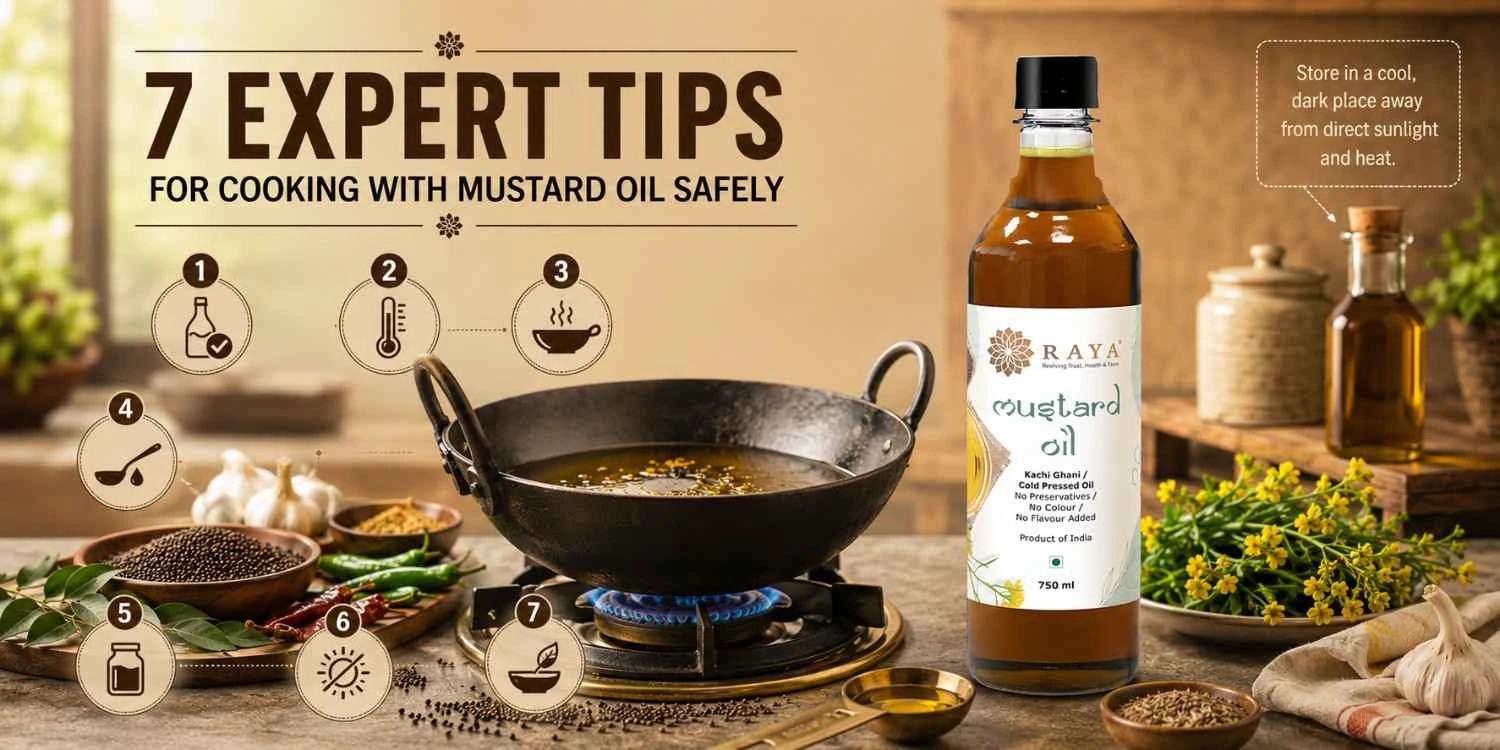
7 Expert Tips for Cooking With Mustard Oil Safely
1. Heat It Properly
Bring mustard oil to the point where it just begins to smoke lightly.
Then reduce the heat before adding spices.
This mellows the raw pungency.
Do not let the oil smoke aggressively for long periods.
2. Don’t Reuse Frying Oil Repeatedly
Repeated reheating increases oxidation.
Discard oil if it:
-
Smells stale
-
Turns unusually dark
-
Foams excessively
-
Feels sticky
3. Store Oil Away From Heat and Sunlight
Heat, light, and air gradually damage oils.
Store bottles:
-
In a cool cabinet
-
Away from the stove
-
Tightly sealed
-
Preferably in dark containers
4. Buy Smaller Bottles if You Cook Infrequently
Fresh oil tastes better and oxidizes less over time.
If you cook occasionally, smaller bottles are smarter.
5. Read Labels Carefully
Check:
-
Extraction method
-
Manufacturing date
-
FSSAI certification
-
Packaging quality
-
Ingredient purity
6. Use Measured Quantities
Even healthy oils are calorie-dense.
Use controlled portions instead of pouring freely from the bottle.
7. Match the Oil to the Dish
This matters more than internet trends.
A smoky Bengali fish curry and a Mediterranean salad need completely different oils.
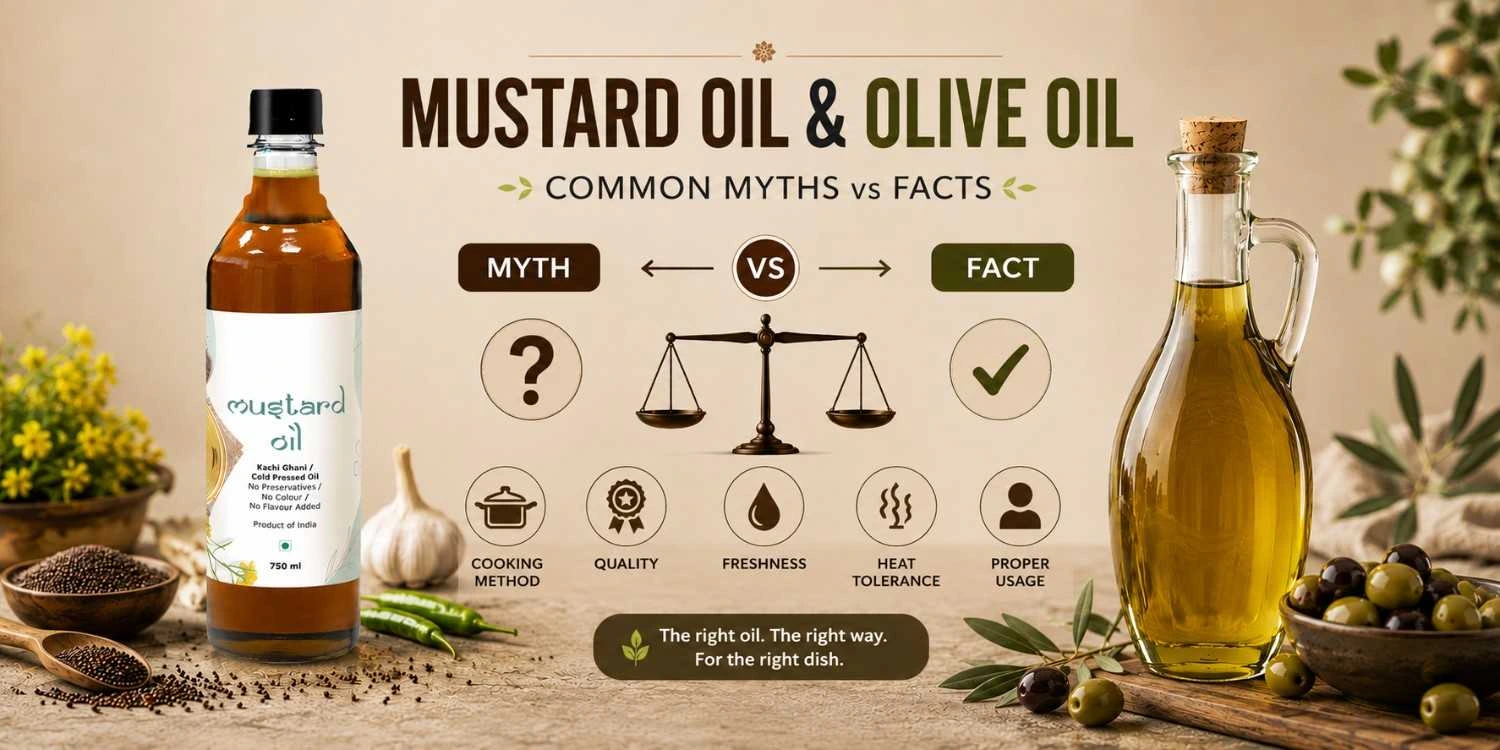
Common Myths About Mustard Oil and Olive Oil
Myth 1: Olive Oil Is Always Healthier
Not necessarily.
The cooking method matters enormously.
A high-quality oil used correctly is more important than blindly following trends.
Myth 2: Mustard Oil Is Unsafe
Culinary mustard oil approved for cooking continues to be widely used in Indian households.
Quality, moderation, and proper sourcing matter most.
Myth 3: Extra Virgin Olive Oil Cannot Be Heated
EVOO can handle moderate cooking.
However, extremely high temperatures reduce many of its delicate flavor compounds.
Myth 4: Smoke Point Is the Only Thing That Matters
Smoke point is important, but not the only factor.
Also consider:
-
Flavor compatibility
-
Processing quality
-
Freshness
-
Cooking duration
-
Reheating frequency
Frequently Asked Questions
1. Is mustard oil healthier than olive oil?
Neither oil is universally healthier. Mustard oil suits traditional Indian high-heat cooking better, while extra virgin olive oil works best for low-heat cooking and raw applications.
2. Can I use olive oil for Indian cooking?
Yes. Olive oil works well for light sautéing and fusion recipes. However, extra virgin olive oil is not ideal for prolonged smoking-hot tadka.
3. Why do Bengali recipes use mustard oil?
Mustard oil contributes a signature pungent flavor that defines many Bengali dishes, especially fish curries and vegetable fries.
4. Is kachi ghani mustard oil better than refined mustard oil?
Kachi ghani mustard oil is less processed and usually retains stronger aroma and flavor. Refined mustard oil has a milder taste.
5. Which oil is better for frying?
Mustard oil generally performs better for traditional Indian frying because of its flavor compatibility and high heat tolerance.
6. Can mustard oil help heart health?
Mustard oil contains mostly unsaturated fats, but heart health depends on your overall diet, lifestyle, and portion control — not a single ingredient alone.
7. Does olive oil lose benefits when heated?
Extra virgin olive oil loses some delicate flavor compounds and antioxidants during prolonged high-heat cooking.
8. How do I choose good mustard oil?
Look for:
-
Cold-pressed or kachi ghani labeling
-
FSSAI approval
-
Fresh manufacturing date
-
Trusted brands
-
Proper packaging
Final Verdict
If your kitchen revolves around Indian curries, tadka, frying, and pickling, mustard oil remains one of the most practical and flavorful choices available.
If your meals include salads, grilled vegetables, dips, or Mediterranean dishes, extra virgin olive oil deserves a place too.
The healthiest kitchen is not built around food trends.
It’s built around understanding how ingredients behave in real cooking.
For most Indian households, the smartest approach is simple:
Use mustard oil for traditional Indian cooking. Use olive oil where its natural flavor and antioxidants shine best.
Ready to Choose the Right Cooking Oil?
Next time you shop for cooking oil, don’t just look at marketing claims.
Flip the bottle and check:
-
Extraction method
-
Manufacturing date
-
FSSAI certification
-
Intended cooking use
If you cook Indian food regularly, a good kachi ghani mustard oil like Raya can elevate everything from dal tadka to fish curry with authentic flavor and reliable performance.
Start with one traditional recipe this week. Cook it with mustard oil. Taste the difference for yourself.
Follow us for more wellness tips
👉 Buy Now on rayaoniss.com
👉Also available on Amazon & Flipkart
📸 Instagram: instagram.com/raya_oniss
📘 Facebook: facebook.com/RAYA.ONISS
▶ YouTube: youtube.com/@RAYA-ONISS