

Have you ever wondered how Bilona Ghee is made?
The traditional process starts with fresh milk. The milk is first turned into curd. Once the curd is ready, it is churned until the butter separates from the liquid. The collected butter is then gently cooked until it turns into aromatic ghee.
This method has been used in Indian households for generations. It takes more time than many modern ghee-making methods. It also involves several careful steps.
In this guide, you will learn how Bilona Ghee is made from milk to the final product. We will also explain the difference between Bilona Ghee and regular ghee. You will learn how to choose good Bilona Ghee and what to check before buying it.
What Is Bilona Ghee?
Bilona Ghee is traditionally made from curd rather than directly using cream.
The process starts with milk. The milk is converted into curd. The curd is then churned to separate butter. Finally, the butter is slowly heated and clarified to make ghee.
The simple process is:
Milk → Curd → Churning → Butter → Slow Heating → Filtration → Ghee
The word Bilona is linked to the traditional method of churning curd to separate butter.
This is important to understand because Bilona refers to the method of preparation. It does not automatically mean that the ghee is A2.
What Makes the Bilona Method Different?
The main difference is the way the ghee is prepared.
Traditional Bilona preparation generally includes:
-
Fresh milk
-
Curd setting
-
Churning
-
Butter separation
-
Slow heating
-
Filtration
The process takes more time and involves more stages.
Modern commercial ghee can be made using different methods. Some methods may start with cream or separated butter.
Therefore, it is always useful to check how a product is actually made.
How Is Bilona Ghee Made?
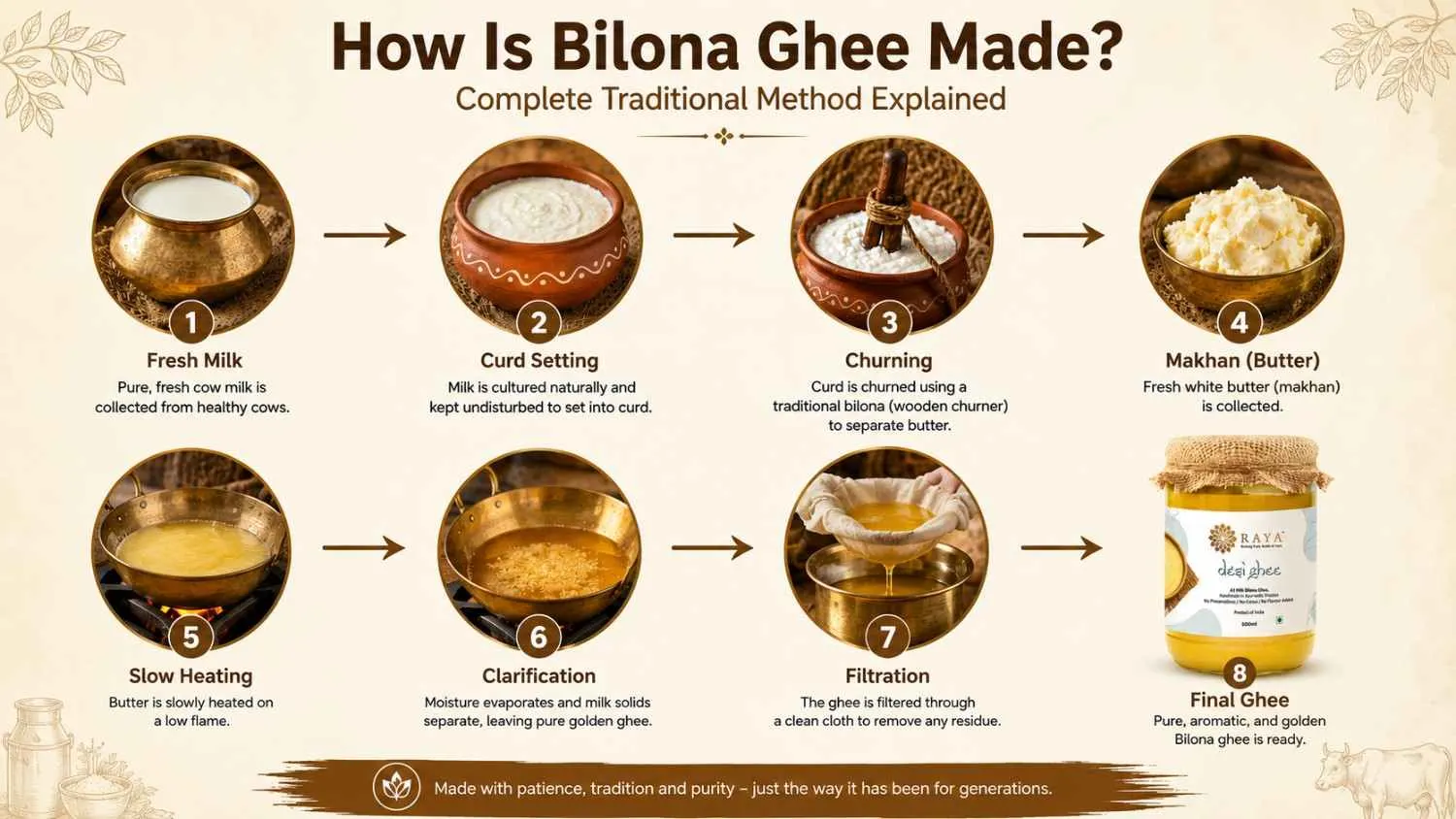
The traditional Bilona Ghee process follows these main steps:
Fresh Milk → Curd → Churning → Makhan → Slow Heating → Clarification → Filtration → Ghee
Let's understand each step in detail.
Step 1: Fresh Milk Is Collected
The process starts with fresh milk.
Milk quality is important because it is the main raw material. The source and handling of the milk can affect the final product.
A responsible producer should maintain proper hygiene during milk collection and handling.
Depending on the producer, the milk may go through basic quality checks before processing.
Step 2: The Milk Is Heated
The milk is heated before it is prepared for fermentation.
After heating, it is allowed to cool to a suitable temperature.
This step prepares the milk for the next stage, which is the curd setting.
The exact heating and cooling process can vary between producers.
Step 3: The Milk Is Converted Into Curd
Once the milk reaches a suitable temperature, a starter culture is added.
The milk is then left to ferment.
Over time, it changes into curd.
This stage is important in the traditional Bilona method. The curd is later churned to separate the butter.
The process is simple:
Milk + Starter Culture → Fermentation → Curd
Step 4: The Curd Is Churned
The set curd is now churned.
This is one of the most important steps in the Bilona method.
Traditionally, a wooden churner called a Bilona is used. The curd is churned until butter separates from the liquid portion.
The result is:
Curd → Butter/Makhan + Buttermilk
The butter is collected for the next step.
Some producers may use controlled mechanical equipment. The tools used for churning may differ from one producer to another, especially when the production volume changes.
Step 5: Butter or Makhan Is Collected
After churning, the butter is separated from the buttermilk.
The butter is then collected and prepared for heating.
At this stage, it is still butter. It is not yet ghee.
The butter contains water and milk solids. These need to be separated through heating.
Proper handling is important during this stage.
Step 6: The Butter Is Slowly Heated
The butter is now heated slowly.
As the butter heats, the water starts to evaporate. The milk solids begin to separate from the fat.
The mixture gradually changes in colour, texture and aroma.
The basic process is:
Butter → Heating → Water Evaporation → Separation → Ghee
Controlled heating is important.
Too much heat can affect the flavour and quality of the final product. Therefore, the heating process needs careful attention.
Step 7: The Ghee Is Clarified
As heating continues, most of the remaining moisture evaporates.
The milk solids settle or separate from the fat.
The clear fat portion becomes ghee.
The final colour and aroma can vary. They may depend on the milk, fermentation and heating process.
Colour alone should not be used to judge whether ghee is authentic.
Step 8: The Ghee Is Filtered
The clarified ghee is filtered to remove remaining milk solids.
The filtered ghee is then cooled.
It can now be packed and stored.
Proper hygiene, packaging and storage are important at this stage. Good handling helps protect the quality of the finished product.
Bilona Ghee Process at a Glance
|
Stage |
What Happens |
|
Milk |
Fresh milk is collected |
|
Heating |
Milk is heated and cooled |
|
Curd |
Milk is fermented into curd |
|
Churning |
Curd is churned |
|
Butter |
Butter or makhan is separated |
|
Heating |
Butter is slowly heated |
|
Clarification |
Water and milk solids separate |
|
Filtration |
Ghee is filtered |
|
Packaging |
Finished ghee is packed |
The traditional process has several steps. This is one reason why traditionally made Bilona Ghee may take more time and effort to produce.
Bilona Ghee vs Regular Ghee
Bilona Ghee and regular ghee can differ in their production methods.
However, the term "regular ghee" covers many different commercial processes. Therefore, the exact method can vary from one manufacturer to another.
|
Feature |
Traditional Bilona Ghee |
Conventional Ghee |
|
Starting material |
Traditionally cultured curd/butter |
Method varies |
|
Curd stage |
Yes |
Not always |
|
Churning |
Traditional Bilona-style process |
Often mechanical |
|
Butter separation |
Part of the process |
Depends on method |
|
Production time |
Generally longer |
Often faster |
|
Production scale |
Often smaller |
Usually larger |
|
Price |
Often premium |
Usually more affordable |
|
Flavour |
Rich and traditional |
Varies by process |
The key difference is the production method.
Consumers should check the product information instead of judging quality only by price or colour.
Bilona Ghee vs A2 Ghee: Are They the Same?
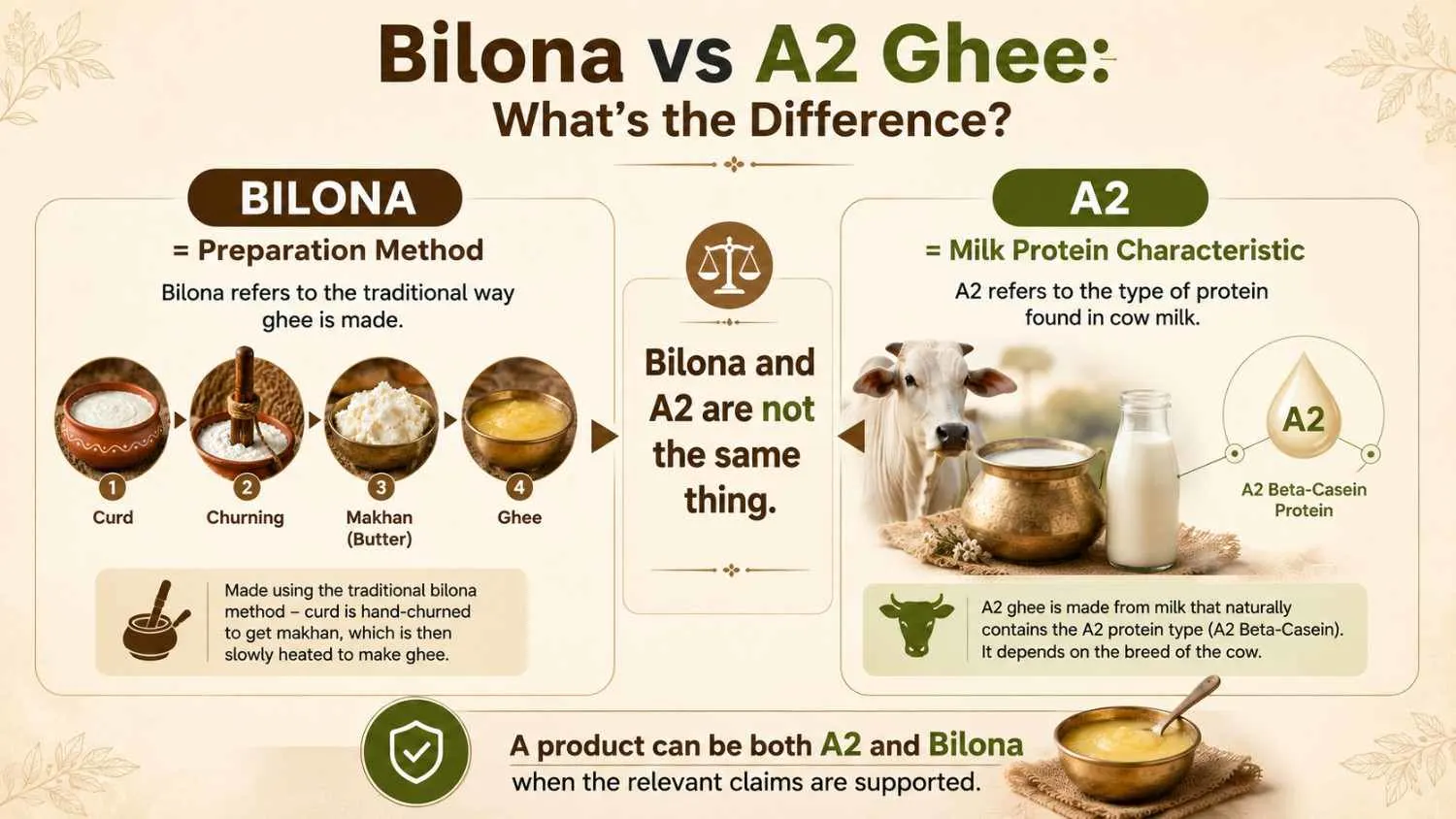
No. Bilona and A2 are not the same thing.
Bilona refers to the way ghee is prepared.
A2 refers to a type of beta-casein protein found in milk.
So, the two terms describe different things.
|
Factor |
Bilona |
A2 |
|
Refers to |
Preparation method |
Milk protein characteristic |
|
Main focus |
How ghee is made |
Type/source of milk protein |
|
Automatically the same? |
No |
No |
|
Can they be combined? |
Yes |
Yes |
A product can be marketed as both A2 and Bilona when its milk source and production process support those claims.
This distinction is useful when comparing ghee products.
What Are the Benefits of Bilona Ghee?
Bilona Ghee is popular among people who value traditional food preparation.
However, it is important to separate traditional beliefs from proven health claims.
1. Traditional Preparation
Bilona Ghee follows a traditional method.
It uses curd, churning and butter clarification.
For many consumers, this traditional process is an important part of the product's appeal.
2. Rich Taste and Aroma
Ghee is known for its rich flavour and aroma.
The final taste can depend on several factors.
These include:
-
Milk source
-
Fermentation
-
Churning
-
Heating
-
Storage
Traditional preparation may give the ghee a distinctive sensory profile.
3. Useful for Everyday Cooking
Ghee is widely used in Indian cooking.
It can be added to:
-
Dal
-
Rice
-
Khichdi
-
Roti
-
Paratha
-
Vegetables
-
Traditional sweets
It can add a rich taste and aroma to everyday meals.
4. Greater Process Transparency
A good Bilona Ghee brand should be able to explain its production process.
Consumers can look for information about:
-
Milk source
-
Curd preparation
-
Churning
-
Butter separation
-
Heating
-
Filtration
-
Packaging
Clear information helps consumers make better buying decisions.
5. Nutritional Value
Ghee is mainly made up of fat.
It is also a concentrated source of dietary energy.
Ghee may contain fat-soluble vitamins. The exact nutritional profile can vary based on the milk and production process.
Because ghee is calorie-dense, portion size is important.
Are There Any Disadvantages of Bilona Ghee?
Bilona Ghee may not be the right choice for everyone.
Here are some factors to consider.
Higher Price
Traditional preparation usually involves more steps.
It can also require more time and labour.
As a result, Bilona Ghee is often more expensive than conventional ghee.
Longer Production Time
The traditional process takes several stages:
Milk → Curd → Churning → Butter → Ghee
Each stage requires time and careful handling.
Not Every Bilona Claim Is the Same
The word "Bilona" alone does not tell you everything about a product.
Before buying, check:
-
Ingredients
-
Milk source
-
Production method
-
Manufacturer information
-
Batch details
-
Quality information
Ghee Is High in Calories
Ghee is a concentrated source of fat and calories.
People who need to manage their calorie or fat intake should consider their overall diet.
If you have a specific medical or dietary condition, speak with a qualified healthcare professional or registered dietitian.
How Much Milk Is Needed to Make 1 Litre of Bilona Ghee?
There is no single milk-to-ghee ratio that works for every producer.
The final yield can vary.
Several factors can affect the amount of ghee produced, including:
-
Milk fat content
-
Milk source
-
Season
-
Fermentation
-
Butter recovery
-
Processing conditions
For this reason, a fixed number should not be treated as universal.
A transparent producer can explain its own process and actual yield.
This is more useful than using a generic milk-to-ghee ratio.
How to Identify Authentic Bilona Ghee
Buying good Bilona Ghee requires more than checking its colour.
Use the following checklist.
Check the Ingredient List
Read the ingredient declaration carefully.
It should clearly tell you what the product contains.
Check the Production Method
Look for information about the actual Bilona process.
Does the producer explain the curd and churning stages?
Clear information is a positive sign.
Check the Milk Source
If the product makes specific milk-source claims, check whether the brand provides supporting information.
Check Manufacturer Details
Look for:
-
Manufacturer name
-
Address
-
Batch number
-
Product details
-
Regulatory information
Do Not Judge Ghee Only by Colour
Ghee colour can naturally vary.
It can depend on milk source, season and processing.
Therefore, colour alone cannot prove authenticity.
Look for Transparency
A trustworthy brand should be willing to explain its process.
The more useful information you can verify, the easier it becomes to compare products.
Bilona Ghee Buying Checklist
|
What to Check |
Why It Matters |
|
Ingredient list |
Helps you understand the product |
|
Milk source |
Provides sourcing information |
|
Production method |
Helps verify the Bilona process |
|
Manufacturer |
Shows who is responsible for the product |
|
Batch details |
Supports traceability |
|
Packaging |
Helps protect product quality |
|
Quality information |
Builds buyer confidence |
|
Price per 100 ml |
Makes price comparison easier |
Who Should Consider Bilona Ghee?
Bilona Ghee may be a good option for people who value traditional food preparation.
Traditional Food Enthusiasts
If you enjoy traditional Indian foods, you may appreciate the Bilona method.
Premium Ghee Buyers
Some consumers prefer premium products with traditional processing and clear sourcing information.
Consumers Who Value Transparency
If the production process matters to you, choose a brand that clearly explains how its ghee is made.
Families Looking for a Versatile Cooking Fat
Ghee can be used in many Indian recipes.
Still, individual dietary needs are different. Choose portions based on your overall diet and personal requirements.
Expert Tips for Choosing Bilona Ghee
When comparing Bilona Ghee products, look beyond a single marketing claim.
1. Understand the Production Method
Check whether the product actually follows the curd-to-butter-to-ghee process.
2. Do Not Confuse A2 With Bilona
A2 and Bilona describe different things.
A2 relates to milk protein. Bilona refers to the preparation method.
3. Read the Ingredient List
Do not rely only on the front of the package.
Check the complete ingredient information.
4. Check the Milk Source
If milk source or breed is important to you, look for clear information from the producer.
5. Compare the Price Per 100 ml
Different brands sell different pack sizes.
Comparing the price per 100 ml gives you a better idea of value.
6. Look for Traceability
Batch information and manufacturer details can help you understand where the product comes from.
7. Do Not Judge Quality by Colour Alone
Colour can vary naturally.
It is not a reliable authenticity test by itself.
8. Choose Transparency Over Hype
A good brand should explain its process clearly.
For example, when considering Raya Bilona Ghee, review the available information about its sourcing, production process and product quality before making a purchase.
Statistics About India's Dairy Industry
India has one of the world's largest dairy industries.
Dairy products are an important part of the country's food system and daily diet.
For an accurate and up-to-date article, statistics should come from reliable sources such as government publications.
Useful statistics include:
|
Statistic |
Recommended Source |
|
India's milk production |
Department of Animal Husbandry & Dairying |
|
Per-capita milk availability |
Government of India |
|
Dairy sector data |
Official government sources |
|
Dairy market trends |
Reliable industry research |
This makes the information easier to verify and improves content credibility.
Case Study: From Milk to Bilona Ghee
A real production case study can make this article much more useful.
For example, a Bilona Ghee producer can document one production batch from start to finish.
Stage 1: Milk
Record:
-
Milk quantity
-
Milk source
-
Production date
Stage 2: Curd
Document:
-
Starter culture
-
Fermentation method
-
Approximate setting time
Stage 3: Churning
Record:
-
Churning method
-
Equipment used
-
Butter recovered
Stage 4: Ghee Preparation
Document:
-
Butter quantity
-
Heating method
-
Clarification
-
Filtration
Stage 5: Final Yield
Show the complete journey:
Milk → Curd → Butter → Final Ghee
Actual production figures are much more useful than a generic claim about yield.
If available, Raya can strengthen this section by showing original production photographs, sourcing details and batch information.
How to Use Bilona Ghee in Everyday Cooking

Ghee is a versatile ingredient in Indian kitchens.
You can use it with:
-
Dal
-
Rice
-
Khichdi
-
Roti
-
Paratha
-
Vegetables
-
Traditional sweets
A small amount can add flavour and aroma to a dish.
Since ghee is calorie-dense, use it according to your dietary needs.
How Should Bilona Ghee Be Stored?
Proper storage helps maintain product quality.
Follow these simple practices:
-
Keep the jar tightly closed.
-
Always use a clean and dry spoon.
-
Keep water away from the product.
-
Avoid direct sunlight and excessive heat.
-
Follow the storage instructions on the product label.
Good storage also helps protect the flavour and quality of the ghee.
Frequently Asked Questions About Bilona Ghee
1. What is Bilona Ghee?
Bilona Ghee is traditionally made by converting milk into curd, churning the curd to separate butter, and slowly heating the butter to make clarified ghee.
2. How is Bilona Ghee made?
The traditional process is:
Milk → Curd → Churning → Butter → Slow Heating → Filtration → Ghee
3. Is Bilona Ghee made from curd?
Yes. Traditional Bilona preparation uses curd as the starting point for churning.
4. What is the Bilona method?
The Bilona method is a traditional way of making ghee. It involves churning cultured curd to separate butter before heating the butter to make ghee.
5. Is Bilona Ghee the same as A2 Ghee?
No. Bilona refers to the preparation method. A2 refers to a characteristic of milk protein. A product can potentially be both A2 and Bilona when the relevant claims are supported.
6. Is Bilona Ghee better than regular ghee?
It depends on your preferences. Bilona Ghee may appeal to people who value traditional preparation and process transparency. However, product quality varies between manufacturers.
7. Why is Bilona Ghee expensive?
Traditional Bilona production can require more time, labour and processing steps. These factors can increase production costs.
8. How much milk is required to make 1 litre of Bilona Ghee?
There is no fixed amount for every producer. Yield depends on milk fat, milk source, butter recovery and processing conditions.
9. How can I identify authentic Bilona Ghee?
Check the ingredient list, milk source, production method, manufacturer details and batch information. Do not rely only on colour or texture.
10. Can Bilona Ghee be used for cooking?
Yes. Ghee is commonly used for dal, rice, roti, paratha, vegetables and many traditional Indian recipes.
11. Is Bilona Ghee suitable for everyone?
Not necessarily. Individual dietary needs vary. If you have a specific health or dietary concern, consult a qualified healthcare professional.
12. How should Bilona Ghee be stored?
Keep it tightly closed and use a clean, dry spoon. Keep moisture away from the product and follow the storage instructions on the label.
13. Where can I buy Bilona Ghee online in India?
You can buy Bilona Ghee from brand websites, online grocery stores and marketplaces. Before buying, compare the production method, ingredients, sourcing and quality information.
Conclusion
The traditional Bilona Ghee process starts with milk and follows several careful stages.
First, milk is converted into curd. The curd is then churned to separate butter. The butter is slowly heated and clarified. Finally, the ghee is filtered, cooled and packed.
This process takes more time than many modern production methods. It is also closely connected with traditional Indian food practices.
However, the word "Bilona" should not be the only factor you consider when buying ghee. Check the milk source, ingredients, production method, manufacturer details and quality information.
also remember that Bilona and A2 are different terms. Understanding this difference can help you make a more informed choice.
Looking for Traditionally Prepared Bilona Ghee?
If you are looking for traditionally prepared ghee, explore Raya Bilona Ghee and review the available product, sourcing and quality information before buying.
Check the process. Understand the source. Compare the quality. Then choose the Bilona Ghee that fits your needs.